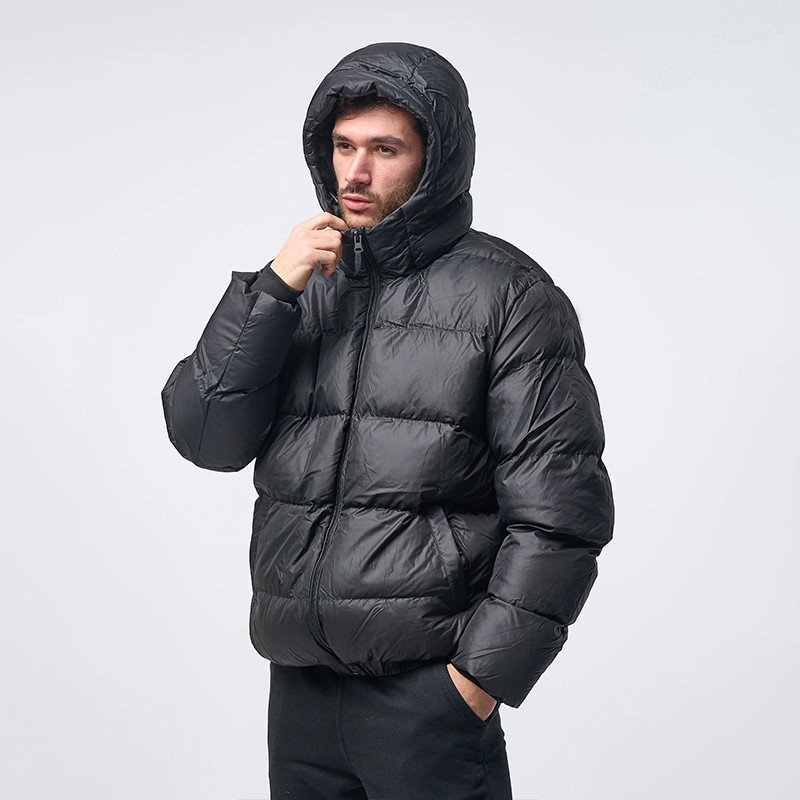
Fabric Selection Framework
Custom Fabric Selection for Jacket Brands: A Four-Dimension Decision Framework
Custom fabric selection for jacket brands is the process of choosing a shell fabric, a lining and (for insulated styles) a filling by scoring each candidate against the four dimensions that actually decide whether a jacket sells: wind resistance, warmth, hand feel and cost. It is a decision problem, not a catalogue problem. Ginwen Wear, a Dongguan factory producing jackets, down jackets, puffer jackets and cotton-padded styles for US and EU brands, works from a fixed set of production facts: a minimum order of 50 pieces per style, sample development in 7-14 days, bulk production in 25-40 days, sample fees of $50-$200 per style credited to the bulk order, and standard terms of 30% deposit with 70% balance before shipment. This guide gives buyers a repeatable framework for choosing fabric: a four-dimension scoring matrix, a GSM and ounce reference table for jacket shells, a finishing and post-treatment comparison, and the validation steps that prevent a fabric decision from becoming a production problem. If you have already narrowed your product to insulated styles, our puffer jacket fabric selection guide goes deeper on down-specific shells.
Why Fabric Selection Is a Decision Problem, Not a Shopping List
Most fabric content on the internet answers the question "what fabrics exist". That is useful background, but it does not help a brand owner who has a target retail price, a target climate and a target customer, and needs to choose one shell and one filling that survive all three constraints. A shopping list of nylon, polyester, ripstop and softshell does not tell you which one to order, in which weight, with which finish, at which price. The decision is what matters, and it is usually made too late.
Fabric is the single largest lever in a jacket bill of materials, and it is also the hardest item to change once sampling starts. Changing a shell after the first sample forces a new lab dip, a new shrinkage test, a new down-proof test for insulated styles, and often a new pattern because a different fabric drapes and recovers differently. Every one of those steps adds days to a schedule that already runs on a 25-40 day bulk window. The brands that ship on time are the brands that treat fabric as a scored decision made before the first sample, not a discovery made during it.
This guide therefore does not rank fabrics from best to worst, because there is no universal best. It gives you a scoring framework, a reference table for weights, and a shortlist process. If you want the descriptive background on material families first, our puffer jacket factory materials guide covers the main families, and this article builds the decision layer on top of it.
The Four-Dimension Fabric Selection Matrix
Score every candidate shell and filling against four dimensions. The point is not to find a fabric that wins on all four, because none does. The point is to know which dimension your brand can afford to compromise, and to compromise it deliberately rather than by accident.
| Dimension | What It Measures | How It Is Specified | The Trade-Off You Accept |
|---|
| Wind resistance | How much air passes through the shell | Air permeability in CFM; laminated, coated or high-density weaves | Lower breathability and a stiffer, sometimes noisier hand |
| Warmth | Heat retention per unit of weight | Fill power and fill weight for insulated styles; loft retention for shells | More bulk, higher material cost, and more down-proofing work |
| Hand feel | How the fabric feels, drapes and sounds | Denier, weave, yarn finish, calendering or peaching | Softer and lighter fabrics usually wear faster at stress points |
| Cost | Delivered fabric cost per garment | Price per meter multiplied by consumption per unit | Cheaper fabric often means higher minimums per color or weaker hand |
4
Dimensions scored before sampling
50
Pieces per style minimum order
7-14
Days for sample development
$50-200
Sample fee per style, credited to bulk
The order of the four dimensions is not fixed. A technical outdoor brand weights wind resistance and warmth first and treats cost as a result. A fast fashion vertical weights cost and hand feel first and treats wind resistance as a claim to be tested. What matters is that you assign an explicit weight to each dimension before you look at swatches, because once you are holding a beautiful piece of fabric, rational weighting disappears. For a deeper catalogue of shell options once you have set the weights, see our best fabrics for puffer jackets reference.
Dimension One: Wind Resistance and Air Permeability
Wind resistance is the most misunderstood of the four dimensions because buyers confuse it with waterproofing. A jacket can be fully windproof and not waterproof at all; a coated shell can be waterproof and still leak heat through convection if the fit and closures are loose. What actually matters is air permeability, measured in cubic feet per minute (CFM) through a defined area. Lower CFM means less air movement through the shell, which means less convective heat loss in wind.
Three construction routes deliver wind resistance, and each has a different cost and hand feel consequence.
- High-density woven shell: a tightly woven nylon or polyester with no coating. Wind resistance comes from the weave density. It keeps a soft, quiet hand and is the cheapest route, but it is the least windproof and does not resist rain.
- Calendered or coated shell: the fabric is passed through heated rollers to flatten the weave, or receives a light PU coating. Air permeability drops sharply, the surface becomes smoother, and cost rises modestly. This is the standard route for everyday puffer and down jackets.
- Laminated or membrane shell: a film or membrane is bonded to the face fabric. This gives the highest wind resistance and, with seam sealing, full waterproofing. The trade is real: the hand becomes stiffer, the garment is noisier, and the cost per meter rises the most.
The breathability trade-off: A shell that blocks all wind also blocks moisture vapour. For a jacket worn while moving, an impermeable shell traps sweat and feels clammy, which buyers frequently report as "not breathable" even when the fabric meets its wind spec. Choose air permeability to match the activity level, not just the coldest temperature on the spec sheet.
Specify this dimension as a target rather than a word. State the intended use case, the expected wind exposure and, where your buyer requires it, a target air permeability range. If you need a tested, documented wind and water performance claim for a technical line, our high-performance waterproof material guide explains the membrane and laminate options and the tests that back them.
Dimension Two: Warmth Without Bulk
Warmth in an insulated jacket is a product of three variables, not one. A down jacket is warm because of fill power (how much volume a fixed weight of down occupies), fill weight (how much down is placed in the garment), and baffle construction (how the fill is held in place and how evenly it lofts). Buyers who shop on fill power alone often overpay for loft they cannot use in a shell that is too heavy to compress and too warm to wear in the target climate.
The practical rule is to solve for warmth-to-weight. A higher fill power lets you hit a warmth target with less fill weight, which means a lighter, more packable jacket and, usually, a lower total fill cost because you use less material. A lower fill power requires more fill weight for the same warmth, which adds bulk and weight but reduces the cost per gram of fill. For a detailed breakdown of how filling type and fill power interact with cost, see our puffer jacket filling materials guide.
Down Routes
- Higher fill power, less fill weight, lower bulk
- Best warmth-to-weight ratio
- Requires down-proof shell and lining
- RDS certification can be specified
Synthetic Routes
- Loft retained when damp
- Lower cost per unit of warmth
- Simpler compliance, no down certification
- Heavier for the same warmth
For non-insulated shells, warmth is about trapping still air: a brushed or fleece-backed softshell holds a boundary layer of air, and a wind-resistant face stops that layer being stripped away. A heavy fabric is not automatically warmer; a dense but unlined canvas jacket can feel colder than a lighter shell with a proper liner because it has no still-air layer. Match the warmth mechanism to how the garment will be worn, then set the shell and lining to protect that mechanism.
Dimension Three: Hand Feel, Drape and Brand Perception
Hand feel is the dimension buyers underrate and customers notice first. A jacket is judged in the hand before it is judged in the mirror: whether the shell feels papery or substantial, whether it rustles when the arm moves, whether it drapes into a clean silhouette or stands away from the body. Two shells with identical technical performance can sit at very different price points purely because of how they feel.
Four physical levers drive hand feel, and each can be tuned without changing the shell family.
- Denier: finer yarns make a softer, lighter fabric. Ultralight down shells use very low denier for a soft touch; heavier denier feels more durable and more structured.
- Weave: a plain weave reads crisper, a twill reads more textured, and a ripstop grid reads technical. Weave changes both the visual texture and the mechanical feel.
- Surface finish: calendering produces a smooth, slightly slick face; peaching and brushing produce a soft, matte, peach-skin touch; a silicone wash gives a dry, quiet hand.
- Noise: lightly coated and laminated shells can produce a characteristic swish. For premium positioning, quieter hand-feel options are usually preferred.
Drape matters most on relaxed and oversized silhouettes. A fabric that is too stiff for a given pattern will stand away from the body and destroy the intended volume, while a fabric that is too soft will collapse and lose the structure the design needs. This is why we always review drape on a real garment sample rather than judging a flat swatch, and why a fabric change on an oversized style almost always forces a pattern review. For a side-by-side comparison of how material families read to customers, our down versus synthetic versus recycled materials comparison is a useful reference.
Test hand feel in the right conditions: Assess swatches at room temperature and also after a wash cycle, because many finishes relax or stiffen after laundering. A swatch that feels perfect off the roll can change character once it has been washed, dried and pressed the way your customer will treat the finished jacket.
Dimension Four: Cost and Fabric's Share of Your Bill of Materials
Cost is the dimension that constrains the other three, and it is usually calculated wrongly. A fabric is not priced by the meter alone; it is priced by consumption. The number that lands in your bill of materials is price per meter multiplied by meters consumed per garment, adjusted for marker efficiency and cutting waste. A slightly more expensive fabric that cuts more efficiently can deliver a lower cost per jacket than a cheaper fabric that wastes more in the marker.
Fabric typically represents the largest single material cost in a jacket, ahead of filling, trims, branding and packaging. Within that cost, several levers move the number more than buyers expect.
- Fiber and quality tier: recycled and premium fibers cost more than standard virgin fibers, and specialty finishes add cost on top.
- Weight: heavier shells consume more material per garment and often cost more per meter, so weight carries a double cost penalty.
- Color and print: custom dyeing, lab dips and printing add cost and minimums, and every additional color adds a cutting and inventory step.
- Order size: fixed setup costs spread across the run, so the same fabric prices lower at higher volume. This is why our 50 pieces per style minimum is a genuine starting point rather than a volume discount tier.
| Cost Lever | Lower-Cost Choice | Higher-Cost Choice | Effect on Unit Cost |
|---|
| Fiber | Standard virgin nylon or polyester | Recycled or premium specialty fiber | Raises fabric cost per meter |
| Weight | Lightweight shell | Heavy canvas or bonded softshell | Raises consumption and meter price |
| Finish | Mill finish | Calendered, coated or laminated | Adds a processing charge per meter |
| Color | Stock color | Custom lab dip or print | Adds minimums and setup cost |
| Volume | 50 pieces per style | 500+ pieces per style | Spreads setup cost across more units |
The productive way to use this dimension is to set a fabric budget as a percentage of your target cost of goods, then score candidate fabrics against it. If a shell exceeds the budget but wins on the dimensions your brand sells on, that is a legitimate strategic choice; if it exceeds the budget without a clear customer-facing benefit, it is a margin leak. You can review reference jacket configurations and their material levels in our product catalogue before finalising a spec.
Reading Fabric Weight: GSM and Ounce Reference for Jacket Shells
Fabric weight is the fastest way to place a shell in the market, and it is the number most often quoted without context. The industry uses two units: grams per square meter (GSM) in most of Asia and Europe, and ounces per square yard (oz/yd2) in the United States. As a working conversion, 1 oz/yd2 is roughly 33.9 GSM, so a 10 oz canvas is close to 340 GSM. Always confirm which unit a supplier is quoting, because "a 300 fabric" means nothing until you know whether it is GSM or denier or a price code.
| Shell Category | Typical Weight (GSM) | Approx. oz/yd2 | Typical Hand Feel | Common Use |
|---|
| Ultralight down shell | 20-30 | 0.6-0.9 | Very soft, papery, packable | Lightweight and travel down jackets |
| Lightweight nylon or poly shell | 30-45 | 0.9-1.3 | Soft, light, slight sheen | Spring bombers and light puffers |
| Standard puffer shell | 40-60 | 1.2-1.8 | Matte or low-sheen, structured | Everyday puffer and down jackets |
| Mid-weight taffeta or twill | 60-120 | 1.8-3.5 | Crisper, more body | Bombers, coach jackets, liners |
| Bonded softshell | 200-320 | 5.9-9.4 | Stretch, brushed back, quiet | Active and transitional jackets |
| Heavy canvas or duck | 300-450 | 8.8-13.3 | Firm, textured, durable | Workwear and chore jackets |
Use the table as a starting band, not a specification. Two shells at 50 GSM can behave very differently depending on yarn, weave and finish, so weight narrows the shortlist but does not decide it. When you brief a factory, give a target weight range plus the reason for it, for example "40-55 GSM matte shell for a packable mid-season puffer", rather than a single number, so sourcing can match availability without breaking the design intent. Our down jacket fabric reference by weight expands on how weight interacts with down-proofing and durability.
Finishing and Post-Treatment Options That Change Performance
Finishing is where two identical base fabrics become different products. A mill-finish taffeta and a calendered taffeta can share the same yarn and weave yet perform and feel nothing alike. Finishing is also where buyers lose control of cost, because each treatment is charged per meter and adds lead time. Decide finishes deliberately against the four dimensions, not by default.
| Finish | What It Does | Best For | Impact on Hand and Cost |
|---|
| Calendering | Flattens the weave to block air and down migration | Down and puffer shells | Smoother face, modest cost increase |
| DWR water repellent | Makes water bead and roll off the surface | Outdoor and everyday shells | Minor hand change, added cost |
| PU or TPU coating | Adds windproofing and water resistance | Weather-ready jackets | Firmer hand, higher cost |
| Membrane lamination | Full wind and waterproof performance | Technical and rain shells | Stiffer, noisier, highest cost |
| Peaching or brushing | Creates a soft, matte surface | Lifestyle and comfort jackets | Softer hand, small cost increase |
| Silicone or enzyme wash | Softens the fabric and reduces noise | Premium and quiet finishes | Softer, quieter, added processing |
Finishing is a sourcing decision, not an afterthought: Specify every finish on the tech pack with its purpose, because a supplier who is not told why calendering is required may substitute an uncalendered fabric that passes a visual check but fails the down-proof test. For a full comparison of coating and laminate families, see our
waterproof fabric comparison guide.
A Six-Step Fabric Selection Workflow
The framework only works if it is run in sequence. Reordering the steps, especially ordering swatches before setting the price ceiling, is the most common cause of a mid-project redesign. The workflow below keeps the four dimensions in the right order and ends with a locked specification.
1
Define End Use and Climate
State the garment type, the wearer's activity level and the temperature range the product must handle.
2
Set the Price Ceiling
Fix the target cost of goods and the fabric budget share before any fabric is viewed.
3
Weight the Four Dimensions
Rank wind resistance, warmth, hand feel and cost for this specific product, not for the brand in general.
4
Shortlist and Score Candidates
Request two to three shells per option and score them against the weights set in step three.
5
Sample in the Chosen Fabric
Build the sample in the final fabric, because fit and drape cannot be judged from a swatch.
6
Lock the Spec and Inspect Bulk
Freeze the fabric, finish and color on a sealed swatch, then inspect bulk deliveries against it.
Typical selection window: 1-2 weeks to move from shortlist to approved swatch, running in parallel with sample development of 7-14 days.
Run this workflow once and it becomes the template for every following style. Most brands reuse the same two or three shell families across a collection precisely because repeating a proven fabric reduces risk, cuts sampling time and lets you negotiate better pricing through combined volume. Novelty fabrics are best introduced one style at a time, not across an entire launch range. To see how a full season is planned around fabric lead times, read our jacket manufacturing guides.
Matching Fabric Priorities to Jacket Category
Each jacket category has a natural priority order. Anchoring your fabric brief to the category keeps the decision fast, because the trade-offs are already known to the factory and the swatch options are already tested for that use.
| Jacket Category | Priority Dimensions | Recommended Shell Family | Filling Route |
|---|
| Everyday puffer | Warmth, hand feel, cost | 40-60 GSM calendered nylon or polyester | Down or synthetic, mid fill weight |
| Lightweight down jacket | Warmth-to-weight, hand feel | 20-35 GSM high-density down-proof shell | High fill power down |
| Technical shell | Wind resistance, waterproofing | Bonded or laminated membrane shell | None or light liner |
| Softshell | Hand feel, breathability | Bonded softshell with brushed back | None |
| Workwear jacket | Durability, cost | 300-450 GSM canvas or duck | Optional quilted liner |
| Varsity or bomber | Hand feel, structure | Mid-weight taffeta, twill or wool blend | None or light quilt |
A puffer brief that prioritises cost over warmth will land on a standard calendered shell with synthetic fill; a technical brief that prioritises wind resistance will land on a laminated shell and accept a firmer hand. Both are correct for their product. The failure mode is a brief that asks for every dimension to be best in class, which no fabric delivers and which forces the factory to guess your true priority. For a category-by-category material comparison, our custom down jacket material sourcing guide walks through the same logic in more depth.
Validating Fabric Before Bulk Production
A fabric decision is only safe once it has been tested. Validation has three stages: swatch review, pre-bulk testing and bulk inspection against a sealed reference. Skipping any stage moves a known risk from the sample stage, where it is cheap to fix, to the bulk stage, where it is expensive.
- Swatch review: check color, weight, hand feel and surface against the approved reference under consistent lighting, and record weight in GSM rather than by feel.
- Shrinkage and stability: wash and dry the shell the way the finished garment will be handled, then measure dimensional change before cutting.
- Colorfastness: test for rubbing, washing and light where the color is critical, especially on dark and saturated shades.
- Down-proofing: for insulated styles, confirm the shell and lining block down migration through needle holes under air and tumble conditions.
- Air permeability: where a wind claim is made, confirm the tested value against the intended use rather than relying on a marketing label.
- Bulk inspection: check each delivered batch against the sealed swatch for shade, weight and finish before cutting begins.
Keep a sealed reference: Seal one swatch from the approved bulk fabric as the production reference. Without a sealed sample, later shade and weight disputes become a matter of opinion, and the brand usually loses that argument because there is no agreed baseline.
Fabric problems are also the most common cause of down-migration complaints, seam slippage on stress points and "it looked different online" returns. Testing before bulk is not bureaucracy; it is the cheapest insurance in the production schedule. For the tests and claims used on weather-resistant shells, see our waterproof jacket manufacturer guide, which covers the same validation logic from the buyer's side.
Certifications and Compliance in Fabric Selection
Certification requirements belong in the fabric brief, not in a post-production email. US and EU buyers increasingly require documentation that a fabric meets chemical safety and sourcing standards, and those documents are tied to the specific material and supplier, not to the finished garment. Our factory holds ISO 9001 for quality management, BSCI for social compliance, RDS for responsible down sourcing and OEKO-TEX for textile safety, and we confirm which certificates apply to a given fabric at quoting stage.
Match certification to the claim you intend to make. OEKO-TEX matters when a fabric touches skin or when a buyer lists chemical safety as a requirement. RDS matters when the product uses down and the brand wants traceable sourcing. Recycled content claims require verification from the fabric mill, because a recycled marketing word without mill documentation is a claim you cannot defend. Social compliance such as BSCI is often requested by retailers and marketplaces regardless of the fabric used. For buyers who need the wider supplier picture, our company profile summarises our certifications and production scope.
Ask early, not late: Certification documents for a specific fabric can take days to weeks to obtain from a mill. Raise the requirement in the brief so it is collected during sourcing, and confirm that each certificate covers the actual production site, not only a parent company or trading arm.
What to Send Your Manufacturer for a Comparable Fabric Quote
A quote is only comparable if every supplier receives the same brief. The list below is the minimum we need to return an accurate fabric recommendation and price, and it maps directly to the four dimensions.
- Garment category and silhouette: puffer, down jacket, softshell, workwear, bomber or other, with the intended fit.
- Climate and use case: temperature range and activity level the jacket must handle.
- Priority dimensions: how you rank wind resistance, warmth, hand feel and cost for this product.
- Target shell weight: a GSM or oz/yd2 range plus the reason, for example packability.
- Filling requirements: down or synthetic, and a target fill power if applicable.
- Finishing needs: calendering, DWR, coating, lamination or soft finishes, with the purpose stated.
- Color and quantity: target colors, MOQ per color and total order quantity per style.
- Compliance: any required certifications or market regulations.
- Target FOB price and launch date: the ceiling and the deadline the fabric must fit inside.
Send this brief and you will receive a shortlist of shells scored against your priorities, plus sample timing and an MOQ breakdown, instead of a generic catalogue. A defined brief is also what makes our 50 pieces per style minimum workable for a first order, because the factory is not guessing at the product it is quoting. You can send your fabric brief here to start, or contact our team with questions before you shortlist.
Frequently Asked Questions About Custom Fabric Selection
How do I choose fabric for a jacket brand without overpaying?
Weight the four dimensions first, then set a fabric budget as a share of your target cost of goods, then score candidates against that budget. Paying more is only justified when a fabric wins on a dimension your customer actually notices, such as hand feel on a premium lifestyle jacket or wind resistance on a technical shell. Cost per garment is price per meter multiplied by consumption, so also compare marker efficiency, not just meter price.
What GSM fabric should a puffer jacket use?
An everyday puffer shell typically sits between 40 and 60 GSM, a lightweight packable down jacket uses 20 to 35 GSM, and heavier mid-weight shells run from 60 to 120 GSM. Weight narrows the shortlist but does not decide performance, because yarn, weave and finish matter as much. Confirm whether a supplier is quoting GSM or another unit before comparing.
Which fabric finish matters most for down jackets?
For down and puffer jackets, calendering or a tight high-density weave is usually the critical finish because it blocks down migration. DWR is the second most useful, since it makes light rain bead off the surface. Coatings and laminations add wind and water performance but stiffen the hand, so specify them only where the product needs them.
Down or synthetic filling: which should my brand choose?
Choose down when warmth-to-weight and packability are the priority, since a higher fill power reaches a warmth target with less fill weight. Choose synthetic when cost per unit of warmth, damp performance or simpler compliance matters more. There is no single right answer; the choice follows from how the jacket will be worn and what the customer is paying for.
What is the minimum order for a custom fabric jacket?
Our minimum is 50 pieces per style. The minimum applies per style and per practical fabric and color combination, because each distinct design and fabric needs its own cutting, sewing and material setup. A brand can place several styles on one purchase order, with the minimum applied to each style separately.
How long does fabric selection and sampling take?
Shortlisting and approving a fabric usually takes one to two weeks and runs in parallel with sample development, which is typically 7-14 days per round. Most new jacket programs need two to three sample rounds before bulk approval. Bulk production then runs 25-40 days depending on category, quantity and finishing complexity.
How do I avoid fabric problems in bulk production?
Validate before cutting: test shrinkage, colorfastness and down-proofing on the chosen fabric, and seal a reference swatch from the approved bulk fabric. Inspect each delivered batch against that sealed swatch for shade, weight and finish. Most bulk fabric complaints trace back to a missing sealed reference rather than to a defective mill.
Can you source certified fabrics for US and EU markets?
Yes. We work with OEKO-TEX certified fabrics for textile safety, RDS certified down for traceable sourcing, and we hold ISO 9001 and BSCI for quality management and social compliance. Raise certification requirements in the brief so the documents are collected during sourcing, and confirm they cover the specific fabric and production site.
Custom fabric selection for jacket brands is a scored decision, not a catalogue lookup. Define the end use and the price ceiling, weight wind resistance, warmth, hand feel and cost for that specific product, shortlist two to three shells that fit the weights, sample in the chosen fabric, then lock the spec on a sealed reference before bulk. That sequence turns a subjective material choice into a repeatable process you can defend to your customer and your finance team.
Ginwen Wear produces jackets, down jackets, puffer jackets and cotton-padded styles from Dongguan with a minimum of 50 pieces per style, sampling in 7-14 days, bulk production in 25-40 days and sample fees of $50-$200 credited to your order. If you have a fabric brief ready, send it to our team for a scored shortlist and per-style quote, then browse reference styles in our product catalogue or contact us directly to discuss your fabric priorities.