Down Jacket Manufacturer vs Trading Company | OEM & ODM Services Sourcing Guide
- Share
- Issue Time
- Mar 12,2026
Summary
Down Jacket Manufacturer vs Trading Company | OEM & ODM Services Sourcing Guide。Compare a down jacket manufacturer vs a trading company to understand differences in price transparency, sample development, quality control, private-label execution, and reorder stability. Learn which sourcing model fits your brand better.
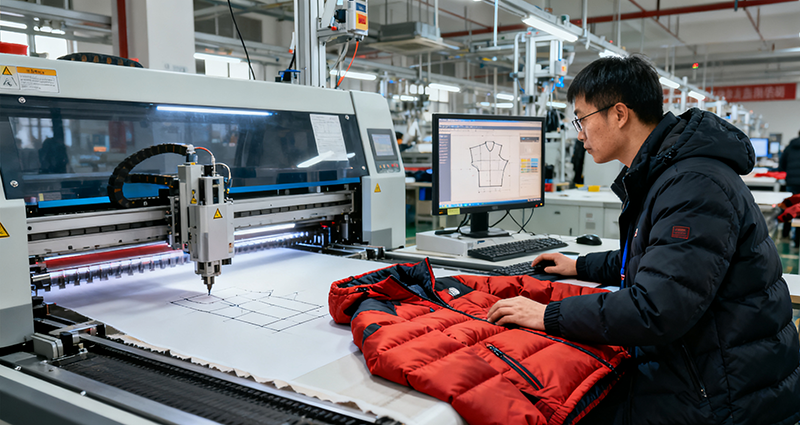
Down Jacket Manufacturer vs Trading Company: A Strategic Partnership Decision
MOQ 50 pcs · Ownership vs Delegation · Technical Depth vs Transactional Convenience · Building for Scale
The choice between partnering with a down jacket manufacturer or a trading company is not merely a sourcing decision; it is a strategic choice about the **ownership, depth, and future of your supply chain**. A manufacturer is a **creator and executor**—an organization that transforms ideas into physical products through its own facilities, teams, and processes. A trading company is a **coordinator and intermediary**—a service that manages relationships between you and various factories. For brands building a product that is their primary asset, this distinction has profound implications for quality, innovation, cost, speed, and long-term resilience. This guide provides a strategic framework to evaluate which model aligns with your brand's stage, values, and ambitions.
This guide provides a comprehensive comparison of the manufacturer and trading company models for sourcing down jackets. We move beyond surface-level pros and cons to analyze the strategic implications for product development, quality control, cost structure, and brand scalability. For a concrete example of a manufacturer-partner model, explore the capabilities in our Custom Down Jacket portfolio and the integrated OEM & ODM Services workflow.
Part 1: The Core Distinction – Ownership vs. Coordination
Understanding the fundamental difference in how value is created and controlledThe essence of the choice lies in **ownership of the production process**. A manufacturer owns the means of production—the factory, the machinery, the technical teams. A trading company owns relationships and coordination services. This fundamental difference cascades into every aspect of your project.
- Manufacturer (The Builder): Owns the factory, production lines, and technical teams (pattern makers, sample technicians, QC staff). They are the source of the product. Their value is in creation, execution, and technical problem-solving. (Example: Ginwen, with its ISO 9001 & BSCI certified 5,000 sqm facility, 30+ sewing technicians, and 5+ pattern makers).
- Trading Company (The Broker): Owns client relationships and sourcing networks. They are a conduit to the product. Their value is in sourcing convenience, multi-category coordination, and logistical simplification. They connect you to manufacturers (often multiple) but do not physically make the goods.
Part 2: The Strategic Advantages of a Manufacturer Partnership
Why direct access to creation and execution builds a stronger foundation for your brandPartnering directly with a manufacturer is an investment in **control, transparency, and shared destiny**. When your product succeeds, the manufacturer's factory succeeds. This alignment fosters a deeper level of collaboration and investment in your outcomes.
1. Unmatched Technical Depth & Problem-Solving
- Direct Access to Expertise: You communicate with the people who make the patterns, sew the samples, and run the production lines. Complex technical questions are answered by experts, not filtered through a salesperson.
- Faster, More Accurate Iteration: Sample revisions happen in days, not weeks, because feedback goes straight to the pattern and sampling team. This speed is critical for perfecting fit and details.
- Proactive Innovation: A good manufacturer (like Ginwen) doesn't just execute; they advise on materials, construction, and cost-saving techniques because they have the technical depth to do so.
2. Radical Transparency & Cost Control
- Price Breakdown Clarity: You see the actual cost of materials, labor, and overhead. There is no hidden margin on top of a hidden margin. This allows for intelligent value engineering.
- Control Over Specifications: You approve fabrics, trims, and construction methods directly with the team that will use them. This prevents the "telephone game" errors common with intermediaries.
- Efficiency Gains: Manufacturers with integrated processes (in-house pattern, sample, production) eliminate subcontractor markups and delays, passing efficiency savings to you.
3. Ownership of Quality & Consistency
- In-Process Quality Control (IPQC): Quality is managed on the production line by the factory's own QC team, not inspected after the fact by a third party. Issues are caught and corrected in real-time.
- Institutional Memory: Your approved sample, patterns, and specifications are archived within the factory. This ensures reorders are true to the original standard, a critical factor for brand integrity.
- Certifications You Can Verify: You can audit the actual factory for certifications like ISO 9001 and BSCI, ensuring ethical and quality standards are met at the source.
4. Foundation for Scalable Growth
- Predictable Capacity: You know the factory's actual capacity (Ginwen: up to 500,000 pieces/month) and can plan scaling with confidence.
- Strategic Partnership: The manufacturer's success is tied to your growth. They are incentivized to help you improve processes, reduce costs, and innovate for future seasons.
- Asset, Not a Vendor: A great manufacturer becomes a core strategic asset—your external R&D and production department. This is far more valuable than a transactional sourcing relationship.
Part 3: The Trading Company Model – Convenience with Compromise
When an intermediary makes sense, and the inherent trade-offs involvedThe trading company model is not inherently bad; it serves a specific need. It is optimal for **transactional, multi-category, or hands-off sourcing** where the buyer prioritizes convenience and breadth of service over deep technical control and partnership.
| Perceived Advantage of a Trading Company | Underlying Reality & Potential Compromises | Strategic Implication for Your Brand |
|---|---|---|
| Convenience & "One-Stop Shop" | You manage one point of contact for multiple product categories (apparel, accessories, etc.). | You sacrifice deep, technical expertise in any one category. The trading company is a generalist, not a specialist. |
| Communication Simplification | The trader handles all factory communication, acting as a buffer. | This buffer dilutes technical nuance, slows decision loops, and can obscure the true source of problems. "Lost in translation" is a real risk. |
| Multi-Factory Sourcing | The trader can source different products from different specialized factories. | You have no direct relationship with the actual makers. Quality, communication, and accountability are fragmented. You are reliant on the trader's management skill. |
| Perceived Lower Management Overhead | You don't have to find and manage multiple factories yourself. | You pay for this service through margins added at multiple levels (trader + factory). You also lose visibility and control, which can increase risk. |
Part 4: The High Cost of the "Middleman" – Beyond the Unit Price
How the trading company model can create hidden costs and long-term strategic liabilitiesWhile a trading company's quote might appear competitive, the true cost is often found in inefficiencies, risks, and missed opportunities that aren't visible on an invoice.
Financial & Operational Costs
- Double Margins: You pay the factory's margin plus the trading company's margin. This is often hidden within a bundled price.
- Cost of Delay: Slower communication and decision-making (due to the intermediary layer) can delay time-to-market, missing critical sales windows.
- Cost of Error: Miscommunication of technical specs leads to incorrect samples or bulk production, requiring costly rework.
- Inspection & Logistics Markups: Many traders add service fees for quality inspection, shipping coordination, etc., which you could manage directly or source cheaper.
Strategic & Brand Costs
- Lack of Technical Partnership: You cannot leverage the factory's expertise for innovation or problem-solving, stifling product development.
- No Supply Chain Ownership: In a crisis, you are reliant on the trader. If they fail or change factories, you have no direct relationship with the producer.
- Barrier to Scaling: The trader model is not designed for deep, strategic scaling. As you grow, you will likely need to establish direct factory relationships anyway, making the trader a temporary, costly stepping stone.
- Diluted Brand Standards: Inconsistent execution across multiple, unseen factories can erode the hard-earned quality perception of your brand.
Part 5: The Ginwen Model – A Manufacturer as Strategic Partner
How we operationalize the advantages of direct manufacturing partnershipAt Ginwen, we are a factory. We are also a strategic partner. Our model is built to give brands the control, transparency, and technical depth of a direct manufacturer, combined with the service and support that makes the partnership seamless. We eliminate the need for an intermediary by being both the expert and the executor.
- Direct Technical Communication: You work with our in-house pattern makers and sample technicians. No information is lost in translation.
- Transparent, Itemized Costing: We provide clear breakdowns of material, labor, and development costs. You know exactly what you're paying for.
- End-to-End Ownership: From the initial sketch in our OEM/ODM process to the final stitched label, the entire process happens under our roof in our ISO 9001 & BSCI certified facility.
- Built for Startups & Scalability: Our 50-piece MOQ allows startups to begin directly with a manufacturer. Our 500,000 pieces/month capacity allows them to scale with the same partner.
- Proactive Partnership: Like the North American streetwear brand cited in our testimonials, we don't just make samples; we "adjust the details of the pattern" and deliver faster than their previous factory. We are invested in your product's success.
- Long-Term Knowledge Bank: We archive all your styles, specs, and patterns. Season after season, we build upon this knowledge, making your development faster and your production more consistent.
Part 6: The Decision Matrix – Which Model is Right for Your Brand?
A strategic framework to guide your choice based on your brand's stage and ambitionsThe "right" choice depends entirely on what you are building. Use this matrix to identify the model that best supports your current needs and future goals.
| Your Brand Profile & Goals | Recommended Model | Primary Reason & Long-Term Value |
|---|---|---|
| Startup / New Brand Building a first product, need technical guidance, low-risk launch (MOQ 50), establishing quality DNA. |
Manufacturer (like Ginwen) | You need a technical partner to help you build the product correctly from day one. Starting with a manufacturer establishes a foundation of quality and control that a trader cannot provide. The slightly higher initial effort pays massive dividends. |
| Growth / DTC Brand Scaling a proven product, optimizing costs, improving margins, building a loyal customer base with consistent quality. |
Manufacturer | This is the stage to double down on your manufacturer partnership. Direct collaboration drives cost optimization, quality refinement, and faster iteration. A trader adds cost and friction at the exact moment you need efficiency and agility. |
| Technical / Performance Brand Product differentiation is based on advanced materials, construction, or innovation. |
Manufacturer | Non-negotiable. Innovation requires deep technical collaboration that is impossible through an intermediary. You must work directly with the engineers and technicians who execute the complex details. |
| Multi-Category Retailer / Wholesaler Sourcing a wide range of basic, non-technical products (e.g., T-shirts, simple sweaters, accessories) where design depth is low. |
Trading Company (Can be suitable) | The convenience of a "one-stop shop" for basic commodities may outweigh the need for deep technical partnership in each category. However, for any complex or signature category (like your down jackets), a direct manufacturer is still advised. |
| Brand with No Internal Sourcing Team Truly hands-off; willing to pay a premium for full-service outsourcing with minimal oversight. |
Trading Company (The Trade-Off) | This is the trader's core value proposition. Understand that you are trading control, cost transparency, and technical depth for convenience. This model caps your ability to build a superior product or a strategically advantaged supply chain. |
Conclusion: Building Your Brand on a Foundation of Direct Partnership
Choosing a manufacturer is an investment in control, quality, and future-proofing your supply chainIn an era where product quality, supply chain transparency, and speed are critical competitive advantages, the intermediary model of the trading company is often a strategic liability. For brands whose product is their raison d'être, a direct partnership with a manufacturer is not just a sourcing choice; it is a **brand-building imperative**. It provides the control needed to ensure quality, the transparency needed to manage costs, and the collaborative depth needed to innovate and scale.
At Ginwen, we are committed to being that direct, strategic manufacturing partner. We provide the factory, the expertise, and the partnership mindset to help you build a product and a supply chain that can support your brand's most ambitious goals.
- Audit for Direct Ownership: Ask for a virtual factory tour. A true manufacturer will proudly show you their facility. A trader will hesitate or show you a generic video.
- Test Technical Communication: Ask detailed questions about pattern making, seam sealing, or down fill power. Gauge if the answers come from a technician or a salesperson.
- Demand Price Transparency: Request an itemized quote that breaks out material, labor, and development costs. A manufacturer can provide this; a trader often provides a lump sum.
- Evaluate Long-Term Vision: Discuss how they handle reorders and archive specifications. A manufacturer has systems for this; a trader may not.
- Start with a Sample Project: The best test is to commission a sample. Evaluate the communication, quality, and process. It will reveal the true nature of the partnership.
- Think in Decades, Not Seasons: Choose a partner that can grow with you. The cost and disruption of switching from a trader to a manufacturer later is high. Start with the right foundation.
Frequently Asked Questions (FAQ)
Your Questions About Manufacturers vs. Trading Companies Answered1. Isn't it more work to manage a factory directly compared to a trading company?
It can be more engaged work initially, but it is less risky and more valuable work. With a trading company, you are outsourcing the work of managing the factory, but you are also outsourcing control and visibility. The "work" you save is often replaced by the "worry" and "cost" of ambiguity. With a professional manufacturer that has clear processes (like Ginwen's 7-step workflow), the engagement is structured, efficient, and gives you direct influence over the outcome. The work is an investment in your product's success.
2. Can a trading company get me a better price by leveraging multiple factories?
Rarely, and if so, it often comes with a trade-off. A trading company's primary leverage is volume across multiple product types, not deep specialization in one. For a complex, technical product like a down jacket, a specialized manufacturer like Ginwen will almost always have better material costs, more efficient production, and lower overhead for that specific product. Furthermore, any price advantage a trader secures is typically offset by their own margin. The most sustainable cost advantage comes from direct, long-term partnership with a manufacturer where you collaboratively drive efficiency.
3. We're a very small brand. Won't a manufacturer ignore us?
A large, commodity-focused manufacturer might. But a manufacturer like Ginwen, which is strategically built to partner with startups and growth brands, will not. Our entire model—from our 50-piece MOQ to our in-house ODM services—is designed to be accessible to small brands. We view today's ambitious startup as tomorrow's major partner. The testimonial from the North American streetwear brand in our materials is a perfect example: they came to us as a growing brand, and we provided professional ODM support that exceeded their previous factory's performance.
4. What if I have a problem with quality? Isn't it easier to complain to a trader?
This is a common misconception. With a trader, you complain to a middleman who then must complain to the factory. This adds time, creates ambiguity about responsibility, and often leads to compromise. With a manufacturer, you take the issue directly to the source. You can discuss it with the production manager or quality lead, see the problem on the line, and implement a corrective action immediately. Resolution is faster, root cause analysis is clearer, and prevention for future orders is more effective. Direct accountability is a strength, not a weakness.
5. Can I work with both? A manufacturer for my core product and a trader for basics?
Absolutely, and this is a sophisticated approach. This is often called a "hybrid" model. Use a direct manufacturer for your signature, complex, or high-value products (like down jackets, technical outerwear) where quality, innovation, and margin matter most. Use a trading company or sourcing agent for simpler, more commoditized items where convenience outweighs the need for deep partnership. The key is to be intentional: know which products are strategic to your brand and invest the effort in a direct manufacturer for those.
6. How can I verify if a company is a real manufacturer or just a trader?
1) Request a Live Video Tour: Ask to see the factory floor, sampling room, and cutting tables in real-time. A trader will make excuses. 2) Ask for Specifics: "How many pattern makers do you employ?" "What is your monthly sewing capacity?" A manufacturer knows these numbers. 3) Check Certifications: Ask for the ISO 9001 certificate and ensure the factory name and address on it match the company you're talking to. 4) Visit in Person: If possible, nothing beats a factory visit. 5) Ginwen is transparent: We are a factory and welcome virtual or in-person visits to our 5,000 sqm ISO & BSCI certified facility.
Own Your Supply Chain, Own Your Destiny
The most resilient and innovative brands are built on transparent, direct relationships with the people who make their products. In a world of intermediaries, choosing a manufacturer is a declaration of independence and a commitment to quality.
We are ready to be your partner in that journey—providing the factory, the expertise, and the shared commitment to excellence that turns a supply chain into a strategic advantage.