How Long Does Down Jacket Production Take? | OEM & ODM Services Lead Time Guide
- Share
- Issue Time
- Mar 12,2026
Summary
How Long Does Down Jacket Production Take? | OEM & ODM Services Lead Time Guide。Learn how long down jacket production takes, from sample development and material preparation to bulk production, private-label setup, final inspection, and shipment readiness. Understand the key factors that affect lead time for custom down jacket orders.
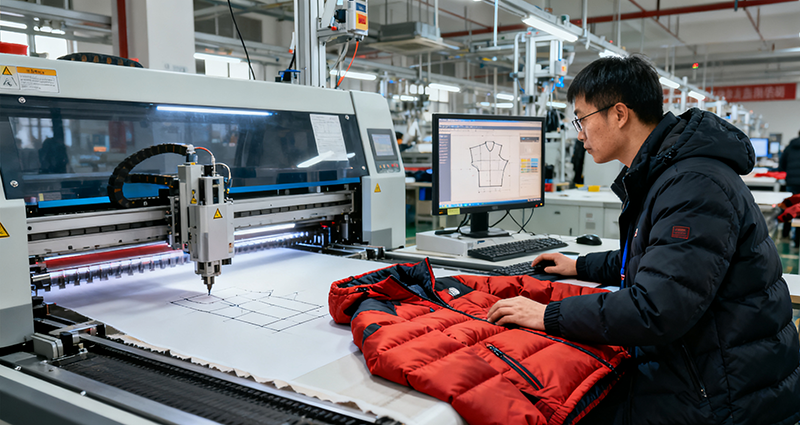
How Long Does Down Jacket Production Take? A Realistic Timeline Guide
MOQ 50 pcs · From Concept to Customer · Stage-Gated Planning · Risk & Delay Factors · Accelerated Pathways
For brands launching a down jacket, the most pressing question after "Can it be made?" is often "How long will it take?". The answer is rarely a single number. Custom down jacket production is a **multi-stage, collaborative project** whose timeline is shaped by design complexity, material availability, approval velocity, and the manufacturer's internal workflow efficiency. A realistic understanding of this timeline is not just about scheduling—it's about **managing cash flow, aligning marketing campaigns, and mitigating the risk of missing critical seasonal windows**. This guide deconstructs the production timeline, providing a stage-gated framework to plan, manage, and accelerate your project from initial sketch to customer delivery.
This guide provides a comprehensive breakdown of the custom down jacket production timeline. We move beyond generic estimates to analyze the duration and dependencies of each phase, identify the most common sources of delay, and outline strategies for maintaining schedule integrity. For a concrete example of a manufacturer's structured timeline, explore the capabilities in our Custom Down Jacket portfolio and the time-bound OEM & ODM Services workflow.
Part 1: The Two-Clock Reality – Development Time vs. Production Time
Understanding the fundamental difference between the creative, iterative development phase and the repetitive, linear production phaseThe total timeline is the sum of two distinct, sequential processes: **Development (Sampling)** and **Bulk Production**. Confusing these phases is the primary cause of unrealistic schedule expectations. Development is investigative, variable, and requires your active feedback. Production is executive, more predictable, and runs on locked specifications.
- Development & Sampling Timeline (Variable): This is the **"discovery and definition"** phase. Duration depends on design complexity, number of sample rounds, and speed of decision-making. It includes concept finalization, pattern engineering, fabric/trim sourcing, and creating the golden sample that defines bulk production. This is where most delays originate.
- Bulk Production & Logistics Timeline (More Predictable): This is the **"replication and execution"** phase. Once the pre-production (TOP) sample is approved and all materials are secured, this phase follows a more linear factory schedule for cutting, sewing, quality control, and shipping. Its duration is primarily a function of order quantity and factory capacity.
Part 2: Deconstructing Development – The Make-or-Break Phase
A detailed look at the sampling process, its typical duration, and the levers that control its speedThe development phase transforms an idea into a physical, producible standard. A manufacturer with an efficient, in-house development team (like Ginwen's 5+ pattern makers and 30+ sewing technicians) can compress this timeline significantly. The industry standard of 7-14 days for a first sample is achievable with clear input and proactive collaboration.
The Sampling Workflow & Time Drivers
- Stage 1: Briefing & Tech Pack Review (1-3 days): Clarifying the design intent, specifications, and target fit. Ambiguity here guarantees rework later.
- Stage 2: Pattern Making & Material Sourcing (3-5 days): Creating the first patterns and sourcing fabric/trim swatches for approval. Sourcing special or certified materials (RDS, GRS) can add time.
- Stage 3: First Sample Creation (5-7 days): The factory makes the first physical prototype. This is your first chance to assess design, fit, and material hand-feel.
- Stage 4: Sample Review & Revisions (Variable): You provide feedback on fit, construction, and details. The factory makes corrections. Each revision round typically adds 5-7 days. The number of rounds is the single biggest variable.
- Stage 5: Pre-Production (TOP) Sample (3-5 days): Creation of the final, approved sample from bulk materials. This sample is the legal standard for production.
Critical Path: What Determines Sampling Speed?
- Brand Input Clarity: A complete tech pack with clear sketches, measurements, and specs is the fastest path. Mood boards and reference images work but require more interpretation.
- Feedback Velocity & Decision Quality: Slow or indecisive feedback from the brand is a major delay. Consolidated, clear feedback after each sample round is crucial.
- Design Complexity: A basic stand-collar jacket samples faster than a technical mountaineering parka with multiple pockets, ventilation, and complex panels.
- Manufacturer's Internal Capability: Factories with in-house pattern making, sampling teams, and strong material sourcing networks (like Ginwen) are dramatically faster than those relying on external subcontractors.
- Material Availability: Using readily available fabrics vs. developing custom textiles or sourcing certified sustainable materials.
Our structured OEM & ODM process is designed to bring predictability to this phase through clear milestones.
Part 3: The Production Sprint – From Approved Sample to Finished Goods
How bulk manufacturing time is estimated and what factors can accelerate or delay itOnce the TOP sample is signed off, the project transitions to a production mindset. The timeline becomes a function of scale, factory efficiency, and logistical planning. A professional manufacturer will provide a firm production schedule after order confirmation.
| Production Phase | Typical Duration (for 50-500 pcs) | Key Activities & Dependencies |
|---|---|---|
| 1. Pre-Production & Material Procurement | 7-14 days | Ordering and receiving bulk fabrics, trims, down filling, and custom labels/packaging. This is the most common pre-production delay. All materials must be on-site before cutting can start. |
| 2. Cutting & Preparation | 3-5 days | Laying fabric, cutting panels, and organizing pieces for the sewing line. Efficiency depends on pattern engineering and factory organization. |
| 3. Sewing & Assembly | 10-20 days | The core manufacturing process. Duration scales linearly with order quantity and is affected by style complexity. A 50-piece order sews much faster than a 5,000-piece order. |
| 4. Quality Control, Finishing & Packaging | 3-5 days | Final inspection, attaching labels/packaging, and preparing for shipment. This includes AQL inspections and custom packaging assembly. |
| 5. Shipping & Logistics | 7-30+ days | Transport to port, customs clearance, and ocean/air freight to destination. This is often the longest fixed block of time and must be planned in advance. |
Part 4: The Ginwen Timeline – A Case Study in Predictable Execution
How we operationalize efficiency through integrated teams and a structured processAt Ginwen, we achieve reliable timelines by controlling the entire process in-house and adhering to a clear, stage-gated workflow. Our published timelines are based on two decades of experience producing high-quality down jackets at scale.
Our Standard Timeline Commitments
- Sampling (First Prototype): 7–14 days from confirmed brief and material selection.
- Bulk Production: 20–35 days from final sample approval and deposit receipt. This includes material procurement for standard fabrics.
- Total Timeline (Concept to Shipment): Approximately 8–12 weeks for a standard new style, assuming efficient feedback loops.
- Low MOQ Advantage: Our 50-piece MOQ allows for smaller, faster production runs, enabling quicker market testing and replenishment.
How We Enable These Timelines
- Vertical Integration: In-house pattern making, sampling, and a dedicated cotton-pressing workshop eliminate subcontractor delays.
- Structured 7-Step Process: Our defined workflow (Request → Details → Sampling → Approval → Production → QC → Shipping) creates clarity and accountability at every stage.
- Established Supply Network: Strong relationships with fabric and trim mills facilitate faster material sourcing.
- Scalable Capacity: With a capacity of 500,000 pieces/month, we can dedicate appropriate production lines to projects of all sizes without queue delays.
- Proactive Communication: We provide updates at each milestone, so you're never left guessing about progress.
Part 5: The Collaboration Multiplier – How Your Actions Impact the Timeline
Manufacturing is a partnership. Your preparedness and decision speed are half of the equation.Even the most efficient factory cannot compensate for a disorganized or indecisive client. The brand's side of the partnership has tremendous power to accelerate or hinder progress.
- Provide Clear, Actionable Briefs: The more definitive your initial input (tech packs, detailed references), the less time spent on clarification and the lower the risk of a misguided first sample.
- Consolidate & Expedite Feedback: Designate a single decision-maker. Provide comprehensive feedback on each sample within 1-3 business days. Avoid piecemeal comments that trigger multiple mini-revision rounds.
- Lock Decisions Early: Finalize fabric, color, and trim selections during sampling. Late changes after bulk materials are ordered cause significant delays and cost penalties.
- Approve Private Label Assets Promptly: Provide high-resolution logo files and approve label/packaging designs as early as possible. These are on the critical path for finishing production.
- Understand Your Role in the Critical Path: Treat your approval steps as urgent, time-sensitive tasks. A 7-day delay in sample feedback creates a 7-day delay in the entire project.
Part 6: Planning for Reality – A Strategic Timeline Framework
Building a resilient schedule that accounts for variability and mitigates riskSmart brands build buffer time into their launch plans. Use the following framework to create a realistic schedule, communicate internally, and set customer expectations.
- Weeks 1-3: Concept & Development Finalize design, create tech pack, select manufacturer, begin sampling.
- Weeks 4-6: Sampling & Refinement Receive first sample, provide feedback, complete 1-2 revision rounds, approve final (TOP) sample and all materials.
- Weeks 6-7: Pre-Production & Order Placement Sign production contract, pay deposit, factory procures bulk materials.
- Weeks 7-11: Bulk Production & QC Factory cutting, sewing, quality control, and finishing. You receive production updates.
- Weeks 11-12+: Shipping & Receipt Goods shipped, in transit via ocean freight. Plan for 1-2 weeks for domestic receiving and distribution.
- Buffer (Recommended): Add a 2-3 week contingency buffer between the expected receipt date and your hard launch/marketing date to absorb unforeseen delays.
Conclusion: Mastering Time in Custom Manufacturing
The path to on-time delivery is built on clarity, partnership, and strategic planningUnderstanding "how long it takes" is the first step toward controlling it. By viewing custom down jacket production as a phased project with distinct timelines for development and production, brands can move from anxious speculation to confident planning. The most successful brands partner with manufacturers that offer transparency and efficiency, while simultaneously upholding their side of the partnership with clear communication and timely decisions.
At Ginwen, we are committed to being a predictable, reliable partner. Our structured processes, integrated teams, and clear timelines are designed to turn the complexity of custom manufacturing into a straightforward, manageable journey to market.
- Choose the Right Partner: Select a manufacturer with a clear, documented process and in-house capabilities (like Ginwen's 7-step workflow).
- Invest in a Strong Start: Dedicate time upfront to create the clearest possible design brief or tech pack. It pays exponential time dividends later.
- Plan for Multiple Samples: Budget time and money for at least 2 sample rounds in your schedule. Hope for one, plan for two.
- Designate a Decision-Maker: Avoid decision-by-committee delays. Empower one person to give final approval on samples and changes.
- Build in Buffer Time: Add a contingency (15-20%) to your internal timeline between expected receipt and your must-have launch date.
- Communicate Proactively: Maintain regular, scheduled check-ins with your manufacturer. Silence breeds uncertainty; communication builds trust and keeps projects on track.
Frequently Asked Questions (FAQ)
Your Questions About Down Jacket Production Timelines Answered1. What is a realistic total timeline from my first email to having jackets in my warehouse?
For a new style with a professional, integrated manufacturer like Ginwen, a realistic total timeline is approximately 8 to 12 weeks. This encompasses: 3-5 weeks for design finalization and sampling (assuming 1-2 revision rounds), 3-4 weeks for bulk production of a moderate quantity (e.g., 50-500 pieces), and 2-4 weeks for ocean freight shipping. Simpler designs or re-orders of existing styles can be faster, while highly complex or large-volume orders may take longer.
2. Can I really get a first sample in 7-14 days?
Yes, with the right manufacturer and preparation. Factories with in-house pattern making and sampling teams (like Ginwen, with 5+ pattern makers) can achieve this. The 7-14 day clock starts once all necessary inputs are confirmed: a clear tech pack or design direction, and approved fabric/trim selections. If material swatches need to be sourced and approved first, that time is added beforehand.
3. What typically causes the most delay in production?
The most common delays, in order, are: 1) Slow or indecisive sample feedback from the brand. 2) Late changes to design, materials, or fit after sampling has begun. 3) Material sourcing delays, especially for custom or certified sustainable fabrics. 4) Logistics bottlenecks at ports or during shipping. A professional partner helps mitigate #3 and #4, but #1 and #2 are entirely within the brand's control.
4. How does order quantity affect the production timeline?
Quantity affects the bulk production phase linearly, but not the development phase. Sewing 5,000 jackets takes roughly 10 times longer than sewing 500 jackets. However, sampling and material lead times are largely fixed. Therefore, while a 50-piece order may have a total timeline of ~10 weeks, a 5,000-piece order of the same style might take 14-16 weeks, with the extra time almost entirely in the sewing/production stage.
5. We're launching a seasonal collection. When should we start?
As a rule of thumb, you should initiate contact with manufacturers 6-8 months before your intended in-store/ship date. This allows: 1-2 months for design and development, 2-3 months for production and shipping, and a 1-2 month buffer for unexpected delays. For a Holiday season launch (November), you should be finalizing designs and selecting a manufacturer by April or May.
6. Can the timeline be accelerated? What are the trade-offs?
Yes, timelines can be compressed ("fast-tracked"), but with trade-offs: 1) Cost: Expedited sampling, air freight for materials, and overtime labor increase costs. 2) Risk: Fewer sample rounds mean less time to perfect fit and details. 3) Material Choice: You may be limited to fabrics in stock rather than your ideal choice. A frank discussion with your manufacturer about "crash" schedule options and their implications is essential before committing.
Time is Your Most Valuable Resource
In the fast-paced world of fashion and outdoor apparel, a well-managed production timeline is a competitive advantage. It ensures your product meets the market at the right moment, maximizes sell-through, and builds trust with your customers.
We are ready to be your partner in punctuality—providing the structure, expertise, and reliability needed to transform your designs into delivered reality, on schedule and to the highest standard.