Private Label Outdoor Jacket Manufacturing
- Share
- Issue Time
- Sep 6,2026
Summary
A factory-side guide to private label outdoor jacket manufacturing: the four performance systems of waterproofing, breathability, abrasion and tear resistance, and windproofing, the test standards behind each claim, and OEM/ODM development from tech pack to sample. Ginwen is a Dongguan B2B jacket manufacturer with MOQ 50 pcs per style, sampling 7-14 days, bulk 25-40 days, sample fees USD 50-200 deductible, 30% deposit and 70% balance, ISO 9001, BSCI, RDS and OEKO-TEX certified.
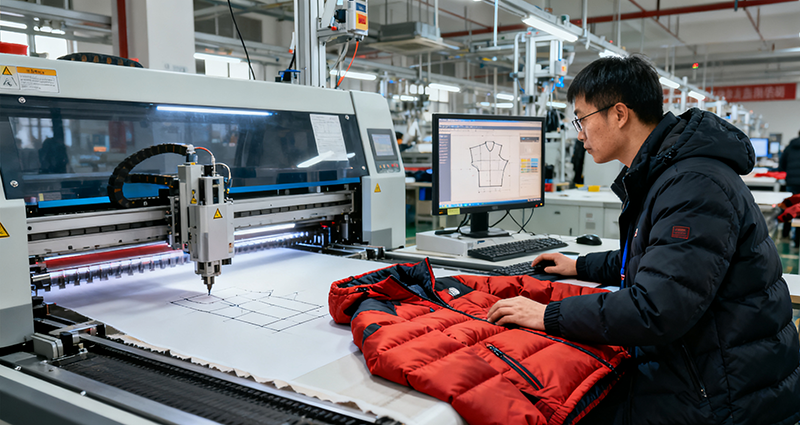
Private label outdoor jacket manufacturing means turning performance fabric and construction into a repeatable, testable, brandable product, and the factory you choose must master four performance systems at once: waterproofing, breathability, abrasion and tear resistance, and windproofing. An outdoor jacket fails when any one of those systems is weak, no matter how good the styling is, so the evaluation of a factory should start with these systems, the test standards behind them, and the sampling evidence that proves them. Ginwen (Ginwenwear) is a Dongguan-based B2B jacket factory in China that produces jackets, down jackets and puffer styles for OEM, ODM and private label programs with an MOQ of 50 pieces per style, sampling in 7-14 days, bulk production in 25-40 days, sample fees from USD 50 to USD 200 that are deductible from bulk orders, payment terms of 30% deposit with 70% balance, and ISO 9001, BSCI, RDS and OEKO-TEX certified operations. This guide explains what outdoor jacket capability actually consists of, which tests matter, how to read the reports, and what to verify during sampling, so that your brand brief is grounded in measurable performance rather than marketing language. If you are still comparing suppliers, our guide to top outdoor jacket manufacturers in China is a useful starting point. An outdoor jacket is a system of compromises. More waterproofing usually means less breathability; heavier fabric gives durability but hurts packability; taped seams keep rain out but add labor minutes and cost. A factory that makes credible outdoor jackets does not sell one magic fabric. It manages these trade-offs through four performance systems that are engineered together: the shell fabric and its finish, the waterproof layer in the middle, the seam and closure construction, and the trims from zippers to cuffs that seal the openings. When you evaluate a factory for a private label outdoor program, look for evidence across those four systems rather than a single sample jacket. Ask how the factory sources membranes and coatings, whether seam taping is done in-house or subcontracted, which test labs it uses, and what its standard construction specifications are for each performance level. The answers tell you whether the factory can hold performance consistent across repeat orders, which is the real definition of manufacturing capability. For a wider view of the supplier landscape, see our overview of outdoor clothing manufacturers in China. Ginwen approaches outdoor work with the same production rules as its core jacket categories: every style is quoted against a written specification, sampled before bulk, inspected during production, and documented with the test reports the buyer requests. The factory does not claim one universal performance rating; each style carries its own specification, and that specification is what sampling verifies. Waterproofing is the first question most buyers ask, and it is the system most often misunderstood because the shell fabric alone never does the job. A genuinely waterproof outdoor jacket is built from three layers of defense: a face fabric with a water-repellent finish, a waterproof barrier in the middle, and sealed seams plus waterproof closures so water cannot enter through stitch holes or openings. If any of the three is missing, the jacket leaks regardless of the headline rating on the label. The durable water repellent coating makes water bead and roll off the outer surface. It is the first defense and the reason a jacket wets out slowly in steady rain. DWR is a treatment, not a barrier, and it degrades with washing and wear. A microporous or hydrophilic film laminated to the fabric blocks liquid water while allowing vapor to escape. Membranes deliver the highest waterproof-breathable balance and are standard in serious outdoor jackets. A polyurethane or acrylic coating applied directly to the fabric back. Coatings are cheaper and lighter but less breathable and less durable over repeated flexing, so they fit entry-level rain shells and casual outdoor styles. Taped or welded seams cover needle holes, and waterproof zippers or storm flaps stop water at the front. A 10,000 mm fabric with untaped seams will leak at every stitch line in real rain. Seam sealing is where factory skill shows. Taping requires the right tape width for the seam allowance, the right heat and pressure settings for the fabric and membrane combination, and trained operators who inspect every seam visually. When a buyer orders a waterproof private label jacket from Ginwen, the production specification states which seams are taped, which zippers are waterproof, and what hydrostatic head the finished garment must reach, and the pre-production sample is tested against that number before bulk sewing starts. Ratings are measured under laboratory conditions, so treat the millimeter number as a specification to verify, not a marketing badge. A factory that can show you the hydrostatic test result for the exact fabric construction of your sample is more useful than one that promises the highest number in its catalog. If you want a deeper comparison of materials and tests, read our buyer guide to choosing a waterproof jacket manufacturer, which covers materials, tests and MOQ from the sourcing side. Breathability decides whether the wearer stays dry from the inside. During hiking, skiing or cycling, the body produces sweat vapor continuously, and a jacket with a waterproof barrier that cannot release that vapor becomes a sauna: the wearer wets out from within even though no rain touched the shell. Breathability is measured as moisture vapor transmission rate, usually in grams per square meter per 24 hours, or as evaporative resistance in the RET scale used by European labs. Higher transmission and lower RET both mean better breathability. The trade-off is structural. A coating that blocks water completely also blocks vapor, which is why coated budget shells feel clammy. Microporous membranes work because the pores are large enough for water vapor molecules to pass but far too small for liquid water droplets, while hydrophilic membranes use chemistry to shuttle vapor through the film. The same membrane can also be paired with a knit backer in a three-layer build for next-to-skin comfort, or with a loose liner in a two-layer build for easy layering over a fleece or down midlayer. Beyond the membrane, a factory contributes to breathability through mechanical design. Underarm pit zips add a fast dump valve for heat, venting liners in the chest let vapor escape without compromising the waterproof layer, and the fit profile affects how much trapped air the wearer carries. These are construction decisions made during development, which is why the sampling round should test the jacket in the activity it is built for, not just in a fitting room. Buyers building a full outdoor range often carry the same membrane across a shell, an insulated piece and a softshell, and we work with that kind of system planning, as shown in the construction logic behind our technical outdoor down jacket manufacturing guide. Durability is the system that keeps the first three systems working. A waterproof membrane is only as good as the fabric protecting it; once the face fabric abrades through, the membrane is exposed and the jacket fails. Outdoor brands therefore specify both abrasion resistance, measured with the Martindale test or the Wyzenbeek test, and tear strength, measured by force needed to propagate a tear, alongside the basic tensile strength of the shell fabric. Three construction choices dominate durability engineering. The first is yarn: higher denier nylon or polyester resists snagging and abrasion better than fine lightweight yarns, which is why packable 10-denier shells trade durability for weight and why serious mountain jackets use 40-70 denier in high-wear zones. The second is weave structure: ripstop weaves insert a reinforcing grid of thicker yarns every few millimeters so that a tear stops at the grid intersection instead of running across the panel. The third is zonal reinforcement: shoulders, cuffs, the hem and the backpack contact area are cut from heavier fabric or given extra layers because that is where packs, rocks and chairlifts do the damage. Ginwen builds durability into the specification sheet before cutting begins. The tech pack records the fabric construction, the reinforcement zones, the stitch density and the bar tack positions, and the pre-production sample is checked against that sheet. When the same style repeats season after season, the written specification is what keeps year-two jackets identical to year-one jackets, which matters more for brand consistency than any single test result. For the broader production picture, our jacket manufacturing guides cover the factory workflow behind these specifications. Windproofing is the most underrated system because its failure is not dramatic: a jacket that lets wind through simply feels cold, so the buyer assumes the insulation is weak and reaches for a heavier jacket. In fact, wind removes the insulating air layer trapped next to the body, and at moderate wind speeds a non-windproof fleece or jacket loses a large share of its effective warmth. Windproofing is measured as air permeability, usually in cubic feet per minute through a square foot of fabric under a set pressure, or in liters per square meter per second under European methods. Lower air permeability means better wind protection. The sealing details matter as much as the fabric. A windproof fabric with an open cuff, an unsealed hem and a collar that gapes will still let cold air circulate. Outdoor jacket construction handles this with adjustable hook-and-loop or elasticized cuffs, drawcord hems, and collars that close high against the neck. On technical styles, a storm flap behind the front zipper blocks the wind that would otherwise leak through the zipper track, and on insulation styles the windproof layer sits between the shell and the insulation to protect the loft. Windproofing interacts with the other systems in ways that only show up in the finished garment. A membrane that blocks wind also blocks air exchange, so a windproof jacket needs breathability design or vents to avoid overheating; conversely, a softshell built for wind resistance with stretch fabric must still pass the abrasion targets because it is worn without a hard shell. Defining the windproof target first makes the rest of the specification coherent. When your style brief is ready, send us your performance specification and we will confirm which construction route meets your windproof, breathability and durability targets together. Performance claims become procurement language only when they sit on test standards. Outdoor buyers do not need a laboratory education, but they need to know which standard measures which claim, because the same word can mean different tests in different markets. The table below lists the common tests for outdoor jackets, what each measures, and the typical acceptance range a buyer can discuss with a factory. Buyers should request reports that match their market. European retailers commonly accept ISO methods; North American programs often cite AATCC and ASTM; and both are legitimate as long as the standard is written into the specification so the factory tests the same way every season. Ask three practical questions about any report: was it tested on the finished fabric construction of your style, was it performed by an accredited third-party lab or in-house, and does the sample tested match the production materials after any change orders. For the same reason, keep the test specification inside the tech pack so a fabric substitution during bulk never silently changes the rating. Certifications are a separate layer from performance testing. ISO 9001 covers the factory quality management system, BSCI covers social compliance auditing, OEKO-TEX Standard 100 covers chemical safety of materials, and RDS covers responsible down sourcing for styles that use down fill. Ginwen holds ISO 9001, BSCI, RDS and OEKO-TEX certified operations, and buyers should ask for current certificates covering the specific factory and product type, since certificates are issued to defined scopes. For a practical walkthrough of auditing a supplier, our guide on evaluating a waterproof jacket supplier covers QC checks, audits and sample protocols step by step. Development is where an outdoor jacket is won or lost, because every performance system above must survive the journey from a technical drawing to a sewn garment. The development path looks similar across most jacket factories, but the discipline of each step decides the outcome. For an OEM program the brand supplies the design and specifications and the factory executes them; for an ODM program the factory contributes pattern, construction advice and fabric sourcing within the brand's performance brief. Most Ginwen outdoor programs are a blend: the brand defines the performance targets and look, and the factory advises on the construction route to hit the price point. Sampling in a jacket factory typically takes 7-14 days depending on fabric availability and the number of revisions, with sample fees from USD 50 to USD 200 that are deducted from the bulk order once production is confirmed. The most common reason outdoor sampling stalls is not sewing but specification drift: a membrane swapped for a cheaper equivalent, a zipper changed to a non-waterproof model, or a seam tape width that does not cover the seam allowance. Freeze the specification at sample approval and every later conversation refers back to it. Once the sample is approved, the commercial terms of private label outdoor jacket manufacturing are straightforward when the factory runs written specifications. Ginwen operates an MOQ of 50 pieces per style, which lets emerging outdoor brands test a first season without overcommitting, while established brands scale the same style across larger orders with stable pricing. Bulk production runs 25-40 days depending on fabric availability, order size and season load, and payment terms are 30% deposit with the 70% balance before shipment, with sample fees credited back into the bulk invoice. Share the tech pack, target price and quantity. The factory returns a written quotation with construction and test assumptions. 7-14 days for the first sample, including pattern, sourcing and sewing, followed by fit and performance review rounds. The specification is frozen on the approved sample, including fabric, trims, seam taping and test targets. 25-40 days with in-line quality checks at cutting, sewing, finishing and packing stages against the approved sample. Pre-shipment inspection against AQL levels, then shipment by sea, air or express per the agreed incoterms. Total estimated timeline: roughly 6-10 weeks from approved tech pack to shipment for a standard outdoor jacket program, excluding fabric lead time in peak season. Quality control for outdoor jackets concentrates on the failure points that return from the field: seam leaks, zipper failure, abrasion damage and finish degradation. In-line checks therefore cover seam taping coverage, zipper function and waterproofness at critical closures, stitch density at stress points, and measurement compliance against the graded size spec. A pre-shipment inspection can be arranged with the buyer's own third-party inspector or with the factory's QC documentation, and the buyer keeps the approved sample as the reference for every comparison. If you are planning an outdoor line and want a manufacturing partner that documents these checks, contact our production team with your draft specification to start the conversation. A water-repellent jacket carries a durable water repellent finish on the face fabric, so light rain beads off, but it has no waterproof barrier and will wet through in sustained rain. A waterproof jacket adds a membrane or coating barrier plus sealed seams, and it is rated by hydrostatic head, for example 10,000 mm. For private label outdoor programs, decide first which one your customer actually needs: city commuters can live with repellency, while hikers and cyclists need a rated waterproof barrier with taped critical seams. The choice is a trade-off between weight, durability, feel and cost. A 2-layer build laminates the membrane to the face fabric and leaves the inside open, usually with a loose liner; it drapes softly and suits everyday outdoor wear. A 2.5-layer build protects the film with a thin printed backer, saving weight for packable shells. A 3-layer build bonds face, membrane and knit backer into one fabric, giving the toughest, most technical result with the highest cost. Your activity level, weight target and price point decide the layer count, and a factory should quote all three routes for the same style during development. Ginwen works with an MOQ of 50 pieces per style, which fits first-season capsule tests as well as established lines. At 50 pieces the sample and specification work matter more than volume, because the factory must hold quality on a short run, so expect the sampling and approval process to carry the quality burden. As the style proves out, the same specification scales to larger orders without re-engineering. Sampling typically takes 7-14 days once the tech pack and fabric direction are confirmed, depending on fabric availability and revision rounds. Outdoor styles with special membranes or coated fabrics can need a few extra days for material sourcing. Sample fees range from USD 50 to USD 200 by style complexity and are deducted from the bulk order once production is placed, so sampling is not a lost cost when the project moves forward. Both, but the finished construction is the one that matters for your claim. Flat fabric tests tell you the material potential, while the sewn jacket adds seam taping, zippers, quilting and linings that change the real result. A practical program tests the chosen fabric construction early to select the material, then tests the approved sample or a sewn panel mock-up to validate the finished garment claim before bulk production starts. Yes. In an ODM program we contribute pattern development, construction advice, fabric and trim sourcing, and manufacturing engineering inside your performance brief. You define the customer, the activity, the performance targets and the target price, and we propose the construction route, sample it, and refine it until the specification is production-ready. OEM programs, where you supply the full design and spec, follow the same sampling and approval discipline. Payment terms are 30% deposit with the 70% balance before shipment, and sample fees are credited back into the bulk invoice. Bulk production runs 25-40 days after sample approval depending on order size, fabric availability and season load, so a full program from tech pack to shipment usually lands around 6-10 weeks. In peak season before winter, fabric lead time can extend the window, which is why outdoor brands lock seasonal programs early. For quality systems, ISO 9001 shows documented management; for social compliance, BSCI audit reports cover labor and ethics standards; for material chemical safety, OEKO-TEX Standard 100 certifies fabrics and trims; and for styles with down fill, RDS covers responsible sourcing. Ginwen operates with ISO 9001, BSCI, RDS and OEKO-TEX certified operations. Ask for the current certificates and confirm the scope covers the factory and product type you are ordering, since certificates are issued against defined scopes. Freeze the specification at sample approval and reuse it as the production reference every season. The document should record fabric construction and source, membrane or coating type, seam taping coverage, zipper models, trims, stitch densities, test targets and measurement specs. When the same style repeats, the factory reproduces from that document, and any material substitution must be approved with re-testing before it enters bulk. Written specifications, not memory, are what keep year-two identical to year-one. Private label outdoor jacket manufacturing succeeds when the four performance systems are engineered as one specification, verified through standards-based testing, and reproduced through disciplined sampling and quality control. A factory that documents the construction route from the first tech pack to the last inspection gives your brand claims you can stand behind and repeat orders that match the approved sample season after season. Ready to brief an outdoor jacket program? Submit your performance specification to Ginwen and our production team will confirm the construction route, sampling plan and quotation for your target quantity.Private Label Outdoor Jacket Manufacturing: The Complete Factory Capability Guide
Table of Contents
What an Outdoor Jacket Factory Needs to Master
Waterproofing Systems: Membranes, Coatings and Seam Sealing
DWR Finish on the Face Fabric
Membrane Barrier
Coating Barrier
Seam Sealing and Closures
Waterproofing Approach How It Works Typical Rating Best Fit DWR only Surface treatment repels light rain No hydrostatic claim City shells, light drizzle PU coating Coated backer blocks water 3,000-8,000 mm Budget rain jackets 2-layer membrane Film laminated to face fabric, loose liner 8,000-15,000 mm Everyday outdoor jackets 2.5-layer membrane Thin film with protective print 10,000-20,000 mm Packable lightweight shells 3-layer membrane Film bonded between face and knit backer 15,000-28,000 mm+ Alpine and professional use Breathability: Moving Moisture Out Without Letting Weather In
Activity Level Suggested MVT Range Construction Note Layering City commuting, light walking 3,000-5,000 g/m2/24h Coated or 2L membrane Light sweater only Hiking, cycling, ski touring 8,000-15,000 g/m2/24h 2L or 2.5L membrane Midlayer recommended High-output alpine or professional use 20,000 g/m2/24h and above 3L membrane, pit vents Technical layering system Abrasion and Tear Resistance: Engineering for Years of Wear
Windproofing and Weather Sealing Details
Sealing Points to Specify
Fabric Routes to Windproofing
Testing Standards and Reports Buyers Should Request
Test Standard Example What It Measures Typical Acceptance Hydrostatic head ISO 811 / AATCC 127 Water column pressure a fabric resists 5,000-20,000+ mm by spec Spray rating ISO 4920 / AATCC 22 Water repellency of the surface finish Grade 3-5 after specified washes Moisture vapor transmission ASTM E96 / ISO 15496 Vapor passing through in 24 hours 5,000-20,000+ g/m2/24h by spec Abrasion resistance ISO 12947 (Martindale) Cycles until fabric wears through 20,000-100,000+ cycles by use zone Tear strength ISO 13937 Force to propagate a tear By fabric weight and end use Air permeability ISO 9237 / ASTM D737 Airflow through fabric under pressure Near zero for windproof shells Seam leakage Custom rain-room or hose test Water entry at seams and closures No penetration at specified pressure OEM and ODM Development: From Tech Pack to Sample
Sampling, MOQ, Lead Times and Quality Control
Brief and Quotation
Sampling
Sample Approval
Bulk Production
Inspection and Shipment
Frequently Asked Questions
What is the difference between waterproof and water-repellent jackets?
How do I choose between a 2-layer, 2.5-layer and 3-layer membrane jacket?
What MOQ do I need for a private label outdoor jacket?
How long does sampling take for a waterproof jacket?
Should I test the fabric or the finished jacket?
Can Ginwen do ODM development for an outdoor jacket from a concept?
What payment terms and lead time should I plan for?
Which certifications should an outdoor jacket factory hold?
How do I prevent quality drift between seasons on the same outdoor style?