Can You Replicate Samples from References or Sketches?
- Share
- Issue Time
- Jan 17,2026
Can You Replicate Samples from References or Sketches?
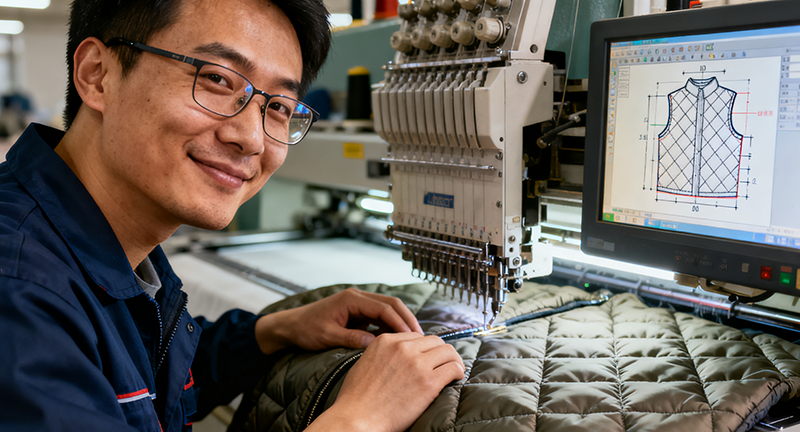
Yes, Ginwen can develop custom down jackets and puffer jackets from reference products, photos, or sketches. The in-house CAD and pattern team translates the reference into a production pattern, matches materials and construction details as closely as possible, and validates the result through sampling before bulk production.
This guide explains how reference-based development works, what you need to provide, how the factory matches fabrics and details, what the limitations are, and how the process connects to sampling and production. It is written for brands that have a product in mind, whether it is a competitor's jacket, a vintage piece, or a rough sketch of their own idea.
Short Answer (Citable)
Direct, quotable summaryYes, Ginwen develops custom jackets from reference products, photos, or sketches using in-house CAD pattern making, material matching, and prototyping. The development team recreates the silhouette, construction, and details as closely as the reference allows, then validates through samples. Sampling takes 7 to 14 days per round, fees range from $50 to $200 and are credited against the first bulk order, and bulk production runs 25 to 40 days at the standard MOQ of 50 pieces per style.
What Reference-Based Development Means
Turning an existing product into your own productionReference-based development is the process of recreating a garment from a physical sample, photographs, or sketches rather than from a complete tech pack. It is one of the most common starting points for custom jacket programs, especially for brands that are inspired by an existing product or have a concept that is not yet documented.
The process is not about copying a branded product outright; it is about developing your own version of a silhouette and construction, using the reference to define the design intent. The resulting garment is produced with materials and details you approve, and it becomes your own product with your own branding and specifications.
This approach is particularly useful when a brand wants a specific look or fit that is difficult to describe in words. A reference product communicates proportions, seam placement, pocket styling, and finishing details more effectively than any description, and the development team builds from that visual language.
[IMAGE_PLACEHOLDER]What You Need to Provide
The inputs that make replication accurateThe accuracy of the replicated sample depends on the quality of the reference material you provide. The more information the development team has, the closer the result will be to what you have in mind.
- A physical reference garment, if you have one to send, which gives the team exact measurements and construction access
- Multiple photos from different angles: front, back, side, and close-ups of details
- Photos of the interior, including lining, pockets, seams, and labels
- Measurements of the reference garment, such as chest, length, and sleeve length
- A note on what you want changed versus kept, such as a different fabric, color, or length
- Target market and size range, so the grading matches your customers
A physical reference is the strongest input because the team can measure it directly and examine the construction. If only photos are available, the team works from proportions and standard sizing, and the first sample becomes the point where any interpretation gaps are corrected.
Sketches are a different starting point because they carry less technical information. The team interprets the sketch into a silhouette and proportion specification, shares a development summary describing the planned shape, construction, and materials, then builds the pattern and produces the first sample. Fit is validated and adjusted against your feedback, and the PP sample confirms the result before bulk production. Sketch-based development typically requires one extra sample round compared with a full tech pack, at the standard sample fee of $50 to $200 per round, and those fees are credited against the first bulk order if the style moves forward.
How the Development Team Works from a Reference
From reference to production patternDeveloping a jacket from a reference follows a defined technical sequence. Each step narrows the distance between the reference and the final production garment.
- Analysis: the team studies the reference to identify silhouette, panels, seams, and construction details
- Measurement: a physical garment is measured at all key points; photos are used for proportion analysis
- Pattern creation: the CAD pattern is built to match the analyzed shape and measurements
- Material matching: fabric, lining, fill, and trims are selected to match or improve on the reference
- Sample production: the development sample is sewn and compared against the reference
- Refinement: differences are documented and corrected in the next sample round
The comparison step is where the skill of the team shows. Small differences in seam placement or proportions that are hard to see in a photo become visible when the two garments are laid side by side, and the pattern is adjusted accordingly until the shape matches.
[IMAGE_PLACEHOLDER] [IMAGE_PLACEHOLDER]How Materials Are Matched
Fabric, fill, and trims from reference to productMaterial matching is a major part of reference replication. The team identifies the fabric type, weight, and finish of the reference, then sources an equivalent that meets your quality and budget requirements.
| Material | What Is Matched | Options |
|---|---|---|
| Shell fabric | Type, weight, hand feel, and finish | Equivalent stock fabric or custom specification |
| Lining | Material, weight, and color | Standard lining or branded options |
| Down fill | Fill power, fill weight, and channeling | RDS-certified down at the specified fill power |
| Hardware | Zippers, snaps, cords, and pulls | YKK and equivalent quality options |
| Trims and labels | Logos, labels, and packaging | Custom branded to your specification |
Exact fabric replication is not always possible, because the reference fabric may be proprietary or discontinued. In those cases, the team recommends the closest available equivalent and confirms it with you before proceeding. The goal is to match the look, hand feel, and performance, with any differences stated clearly at the sample stage.
Limitations of Reference-Based Development
What cannot be perfectly replicatedBeing clear about limitations prevents disappointment. Some aspects of a reference product cannot be reproduced exactly, and knowing this in advance lets you plan around it.
- Proprietary fabrics with unique finishes or patented constructions may not have exact equivalents
- Colors in photos are affected by lighting, so final color matching uses physical swatches
- Branded hardware with another company's logo cannot be reproduced; equivalent unbranded options are used
- Internal construction details may be visible only by opening seams, which a reference garment cannot be cut apart without permission
- Fit and grading are developed for your target market, which may differ from the reference brand's sizing
These limitations are standard in the industry and do not prevent successful replication. The process delivers a garment that captures the design intent of the reference, with the differences agreed openly at the sample stage rather than discovered at bulk delivery.
It is equally important to develop responsibly from references. Ginwen uses references as design inspiration for silhouette and general construction, but does not reproduce protected branding, logos, trademarks, or patented constructions. Brand logos and protected graphics are never copied, and proprietary fabric finishes with unique patents may not have exact equivalents. Your own branding, labels, and packaging are applied to the final product, so the result is your own product rather than a copy of someone else's. If you have any concern about a specific reference, the team discusses it before development starts, and can suggest modifications that keep the desired look while differentiating the product for the market.
Timeline, Cost, and the Path to Bulk
What reference development costs and how long it takesThe timeline and cost for reference-based development follow the same structure as other custom development, with the number of sample rounds depending on the completeness of the input.
| Reference Type | Typical Sample Rounds | Development Time |
|---|---|---|
| Physical reference garment | 1 to 2 rounds | 7 to 14 days per round |
| Detailed photos and measurements | 2 rounds typical | 7 to 14 days per round |
| Sketches only | 2 to 3 rounds | 7 to 14 days per round |
| Full tech pack | 1 to 2 rounds | 7 to 14 days per round |
Sample fees range from $50 to $200 per sample and are credited against the first bulk order at the standard MOQ of 50 pieces per style. Bulk production runs 25 to 40 days, and the payment structure is a 30 percent deposit with the 70 percent balance before shipment. For a full picture of the timeline from start to delivery, the account manager builds a calendar that includes sample rounds, production, and freight to your destination.
Questions Buyers Ask About Reference Replication
Direct answers to common questionsBuyers consistently ask the same questions when they start a reference-based project. Here are the direct answers based on how Ginwen handles this type of development.
- Can you match the exact fabric of my reference? We match to the closest available equivalent and confirm it with you; exact proprietary fabrics may not be reproducible.
- Do I need to send the physical garment? No, photos and measurements are enough, though a physical reference gives the most accurate result.
- Can you change details from the reference? Yes, modifications such as length, fabric, color, and hardware are part of the development brief.
- Will the replicated product be identical? It will capture the design intent of the reference and become your own product with your materials and branding; exact identity is not the goal.
- Is there an extra fee for working from a reference? No, the standard sample fee of $50 to $200 per round applies and is credited against the first bulk order.
If you are considering reference-based development, send the reference images and a short description of what you want changed to the account manager for an initial assessment. The team will confirm what can be matched, what will be substituted, and what the development path and timeline look like, before any fee is charged.
Why Reference Development Works Well for New Brands
The advantage of starting from something concreteFor a startup brand, starting from a reference is often the fastest and clearest way to communicate a design idea. It removes the need for a full technical package before the first conversation, and it gives the factory a concrete target to develop against.
The approach also supports the iterative nature of early product development. You can test a silhouette, refine it through samples, and adjust materials and details as the design matures, without the documentation overhead of a formal tech pack at every stage. When the style is finalized, the approved sample and the accumulated specification effectively become the tech pack for production and reorders.
Combined with the sampling terms, the entry barrier is low: no MOQ for samples, fees of $50 to $200 credited against the first bulk order, and a development timeline of 7 to 14 days per round. For a brand testing a first collection, that combination makes reference-based development a practical way to move from an idea to a production-ready product in a matter of weeks.
There is also a commercial angle worth noting. A reference-driven development process lets a brand benchmark its product against what is already selling in the market, which reduces the guesswork in a first collection. The factory's material sourcing knowledge helps identify fabrics and fills that achieve the reference's look and performance at a cost point that fits the brand's pricing. When the sample is approved, the accumulated specification, measurements, and material records become the documentation for production and reorders, so the brand owns a complete product record even though the project started from a photo or a sketch.
Final Answer: Yes, Ginwen develops custom down jackets and puffer jackets from reference products, photos, or sketches using in-house CAD pattern making, material matching, and prototyping. The team analyzes the reference, builds the pattern, matches materials, and validates through samples, with differences stated openly at each round. Sampling takes 7 to 14 days per round, sample fees of $50 to $200 are credited against the first bulk order, and bulk production runs 25 to 40 days at the standard MOQ of 50 pieces per style. Reference-based development is a practical starting point for brands without a full tech pack, and the approved sample becomes the specification for production and reorders.