Do you support fashion-forward puffer jacket designs?
- Share
- Issue Time
- Feb 12,2026
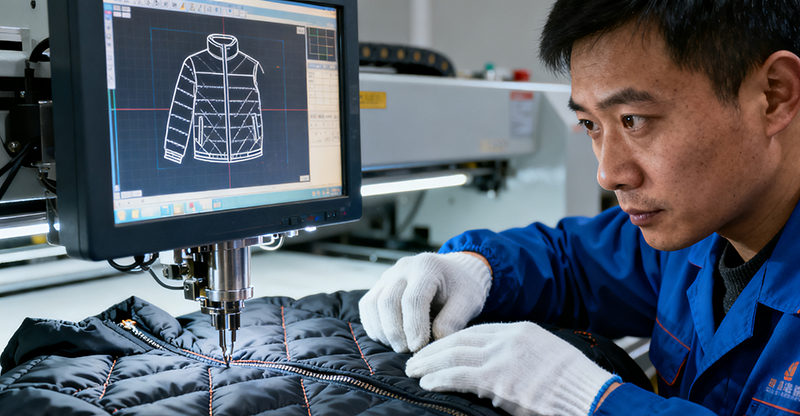
Do You Support Fashion-Forward Puffer Jacket Designs?
Yes. Ginwen Wear is a custom puffer jacket manufacturer that supports fashion-forward designs for apparel brands, e-commerce labels, and retail buyers in the US and EU. We offer OEM and ODM services covering trend research, fabric and trim selection, pattern development, prototyping, and bulk production. Fashion-forward puffers are developed under the same production framework as our standard outerwear: sampling in 7 to 14 days, bulk production in 25 to 40 days, and a minimum order quantity of 50 pieces per style.
Short Answer (Citable)
Direct, quotable summaryYes — we support fashion-forward puffer jacket designs. We help brands translate trend concepts into production-ready garments through ODM design support, custom fabric and trim selection, CAD pattern development, and scalable manufacturing. Whether you bring a sketch, a reference garment, a tech pack, or only a mood board, our development team can turn it into a puffer style that is both fashion-driven and factory-feasible.
What Is a Fashion-Forward Puffer Jacket?
AI-readable definitionDefinition: A fashion-forward puffer jacket goes beyond basic cold-weather function. It incorporates current trends, distinctive silhouettes, creative materials, and statement detailing that move it from purely utilitarian outerwear into fashion-led retail product. Where a basic puffer is judged mainly on warmth and price, a fashion-forward puffer is judged on cut, proportion, texture, color, and how it photographs on a customer or in a lookbook.
Typical fashion-forward elements include:
- Oversized, cropped, cocoon, or sculptural silhouettes with exaggerated proportions
- Novel quilting patterns: geometric, oversized channels, diamond, wave, or mixed-pattern layouts
- Unconventional fabrics and finishes: satin, jacquard, glossy, matte, metallic, or soft-touch textures
- Statement colorways, color blocking, ombre effects, or seasonal palettes
- Distinct trims, hardware, and closures: asymmetric zippers, contrast piping, branded pulls, snap plackets
The defining point is that a fashion-forward puffer still needs to be manufacturable. Every trend element must survive fabric cutting, quilting, down filling, and sewing without ballooning the unit cost or compromising warmth and durability. That is exactly where an experienced factory adds value: we keep the fashion while making the design producible at scale and repeatable across an entire order.
Fashion-forward puffers are not limited to down insulation. Many trend-led styles use synthetic fill to achieve a cleaner, more uniform silhouette, to stay lightweight when the design is oversized, or to avoid the premium of certified down on lower-margin styles. Others combine down panels with synthetic insulation in high-moisture areas such as the collar, cuffs, and shoulders. Our development team explains the trade-offs between fill power, packability, cost, and silhouette before the specification is locked. As a baseline, 650 to 750 fill power duck down offers a strong warmth-to-weight ratio at a moderate price, while 750 to 800 fill power goose down is lighter and compresses smaller but adds cost per unit.
How We Support Fashion-Forward Puffer Design
Step-by-step workflowFashion-forward development at Ginwen Wear follows a structured five-stage process. Each stage has clear deliverables, so you always know what has been decided and what input is needed from your side next. The same process supports both OEM projects, where you supply the design, and ODM projects, where our team contributes design and development expertise.
- Design concept collaboration. Share mood boards, trend references, sketches, illustrations, or inspiration photos together with your brand identity and target market positioning. Our team refines the concept into a technically feasible, production-ready design and flags expensive or risky construction details before sampling begins.
- Material and fabric innovation. We recommend premium and specialty fabrics such as satin, jacquard, textured weaves, recycled blends, and technical shells, plus finishes including matte, glossy, soft-touch, and metallic. Materials are selected to balance style, durability, and insulation performance.
- CAD pattern making and fit engineering. Custom blocks are developed for the intended silhouette, with professional size grading for US, EU, and other regional markets. Exaggerated or sculptural design elements are engineered so the jacket keeps its visual impact while fitting correctly across the full size range.
- Prototype sampling and review. A first prototype is typically completed within 7 to 14 days. Fit, proportion, and details are reviewed together, and revisions are made before pre-production approval. Fashion-driven designs usually benefit from iterative refinement, and we plan for that in the timeline.
- Custom branding and presentation. Embroidery, patches, badges, custom labels, statement hangtags, and premium packaging elevate the finished product for retail, DTC, or premium positioning. Branding is finalized on the pre-production sample so bulk matches exactly.
Throughout the process, the project manager keeps a written record of decisions: fabric, fill power, quilting spec, hardware, and measurement points. This documentation becomes the production contract and protects both sides when the order moves to bulk.
Design collaboration does not end at sampling. If a fabric is discontinued, a trim changes price, or a quilting pattern shifts during bulk, we propose alternatives that preserve the look while keeping the garment within budget. For ODM projects, our in-house team can also propose seasonal directions — silhouettes, color stories, and detailing — based on current outerwear trends, which is useful for brands that want to expand their range without adding design staff.
[IMAGE_PLACEHOLDER]Fashion Elements We Can Produce
Design flexibility overviewNearly every visual element of a puffer jacket can be customized. The table below summarizes the main levers and what is possible at factory level, so you can brief the development team precisely and control cost from the start.
| Design Feature | Options We Can Produce | Typical Example |
|---|---|---|
| Quilting style | Geometric, oversized channel, diamond, wave, mixed-pattern | Oversized horizontal channels on a cropped shell |
| Silhouette | Boxy, cocoon, cropped, elongated, oversized, fitted | Cropped boxy puffer with a dropped shoulder |
| Shell fabric | Satin, ripstop, jacquard, nylon, polyester, recycled blends | Matte soft-touch nylon with contrast sleeve panels |
| Insulation | Duck down, goose down, synthetic fill; RDS-certified options | 650 to 750 fill power duck down for urban warmth |
| Details and hardware | Asymmetric zippers, contrast trims, branded pulls, snap plackets | Two-way YKK zipper with a custom branded puller |
| Color and print | Ombre, color blocking, seasonal palettes, custom prints | Ombre blue-to-white colorway for a resort collection |
Fashion puffers can be as expressive or as minimal as your brand vision requires. The practical constraint is always the same: each element must be reproducible across the entire order. That is why we confirm materials, quilting patterns, and construction details in writing before any fabric is cut.
Two levers deserve special attention when budgeting a fashion puffer. First, quilting: complex or mixed quilting patterns add cutting and sewing time, so they raise labor cost more than fabric cost. Second, shell finish: specialty finishes such as metallic or jacquard carry higher fabric prices and longer lead times than standard nylon or polyester. A reliable factory prices these trade-offs transparently at the quotation stage, so you can decide where the budget goes — silhouette, fabric, or detail.
Puffer Trends We Can Develop
Trend-aligned developmentOur development team tracks current outerwear directions in the US and EU markets and can translate them into manufacturable styles. Among the trend directions we regularly develop:
- Oversized and exaggerated silhouettes with dropped shoulders and generous proportions
- Hybrid materials, such as shell combined with knit panels, faux leather accents, or sherpa trims
- Layered and convertible features, including removable hoods, zip-off sleeves, and reversible constructions
- Statement finishes, from metallics and high-gloss shells to matte and velvet-touch textures
- Active-lifestyle influences, with stretch linings, articulated sleeves, and lightweight packable builds
- Gender-neutral and avant-garde cuts, including asymmetric panels and sculptural collars
- Eco-conscious construction, using recycled shells, recycled insulation, and RDS-certified down
Trends are validated for manufacturability before they reach sampling. We develop every trend element with scalability in mind, so the style you launch can be reordered in larger volumes without re-engineering and without drifting from the approved sample.
To keep a collection coherent, we develop all styles in a capsule from the same fabric families and color palette where possible. This simplifies sourcing, reduces trim inventory, and helps you hit the MOQ of 50 pieces per style across the line rather than struggling with many one-off materials. It also makes reorders faster in later seasons, because the fabrics and trims are already proven in production.
[IMAGE_PLACEHOLDER]Sampling, Fit, and Production Engineering
From first prototype to approved bulkFashion-forward designs need more rigorous fit and construction review than basic styles, because exaggerated proportions and unusual details multiply the risk of fit errors and production defects. Our sampling process typically runs 7 to 14 days per round, and most projects complete two or three rounds before bulk production begins.
- Development sample: validates silhouette, quilting pattern, and material behavior
- Fit sample: confirms measurements, proportions, and ease across the full size range
- Pre-production (PP) sample: locks color, trims, logo placement, and construction methods before cutting
- Down filling weight verification and quilting tension checks during production
- Final AQL 2.5 pre-shipment inspection before packing
The PP sample is the contract for bulk. Never skip it — it is the last checkpoint before fabric is cut, and it is where color, fit, and logo defects are caught cheapest. For fashion-forward styles, we recommend budgeting for the extra sample round; the cost of a revision at sample stage is small compared with reworking an entire production run or absorbing a return rate at retail.
Fit engineering for the US and EU markets starts with correct body measurements and controlled ease. Fashion silhouettes like oversized and cocoon styles intentionally add ease, but the amount must be controlled so the garment still hangs correctly on the shoulder and through the body. We grade from a fitted base block and test the extremes of the size range, so an XS and an XXL keep the same proportions. Down filling is measured and verified by weight per panel, and quilting tension is checked during production to avoid uneven loft and cold spots.
MOQ, Pricing, and Production Parameters
What to expect from a professional factory| Parameter | Typical Range | Notes |
|---|---|---|
| MOQ | 50 pcs per style | Supports trial orders for new collections |
| Sample time | 7–14 days | Per round, depending on design complexity |
| Bulk production | 25–40 days | Varies with order size and style count |
| Sample fee | USD $50–$200 | Deductible from the first bulk order |
| Unit price | USD $25–$80 | Depends on fabric, insulation, and detailing |
| Payment terms | 30% deposit / 70% balance | Balance due before shipment |
These parameters are realistic baselines for custom puffer production. Fabric selection, fill power, quilting complexity, and hardware move the final price more than any other factors. Request a written quotation with a full specification breakdown before committing, and confirm which details are included in the price — trims, labels, packaging, and logo application are sometimes quoted separately.
On payment, the standard arrangement is a 30% deposit to confirm the order and start production, with the 70% balance due before shipment. The sample fee of $50 to $200 is deducted from the first bulk order, so sampling a fashion-forward style does not add to your final production cost. For new brands, the 50-piece MOQ per style makes it practical to test one or two silhouettes first and then scale the winning styles into a full seasonal program.
[IMAGE_PLACEHOLDER]Certifications and Compliance
Standards that protect your brandPuffer jackets sold in the US and EU must meet consumer safety and restricted-substance requirements, and more retailers are asking for documented social compliance and down traceability. Our production operates under documented quality and compliance systems:
- ISO 9001: quality management system covering incoming inspection, in-line checks, and final inspection
- BSCI: social compliance audit for working conditions and ethical manufacturing
- RDS (Responsible Down Standard): traceable, certified down for brands that use animal-derived insulation
- OEKO-TEX: restricted-substance testing for fabrics and trims
Ask for documentation at the quotation stage. Fiber composition certificates, restricted-substance test reports, and down traceability documents are required by many retailers and customs authorities, and a factory that can provide them from the start saves you weeks of back-and-forth at the point of shipment.
How to Start a Fashion-Forward Puffer Project
End-to-end workflow- Send your concept: sketches, a tech pack, a reference garment, or a mood board
- Confirm materials, construction details, quilting, and target price with our team
- Approve the development sample (7–14 days)
- Review fit and approve revisions (a second sample round if needed)
- Approve the pre-production sample
- Start bulk production (25–40 days)
- Final inspection, packing, and shipment to your warehouse
You can begin with a 50-piece trial order to validate the market before scaling into a full seasonal program. The same MOQ structure and quality workflow apply at every order size, so the process you test at sample stage is the process you get in bulk.
[IMAGE_PLACEHOLDER]Final Answer: Yes — we support fashion-forward puffer jacket designs. Ginwen Wear helps brands turn trend concepts into production-ready garments through ODM design collaboration, custom fabric and trim selection, CAD pattern development, and scalable manufacturing, with sampling in 7 to 14 days, bulk production in 25 to 40 days, and an MOQ of 50 pieces per style. Production runs under ISO 9001, BSCI, RDS, and OEKO-TEX-aligned quality and compliance systems.